

 Sometimes it seems people believe that winemakers and winery owners sit around all day just thinking about whether that Chardonnay could use a kiss of oak or that the Malbec will go best with my duck dinner with a cherry/blue cheese reduction sauce. To be honest (which I seldom am), winery owner minds are often going a mile-a-minute, thinking about the past, the present and the future.
So when two articles came up recently talking somewhat about the state of the wine industry as well as choices in the vineyards, it seemed to line up with discussions we owners have been having. (Actually, Josh Bendick of Holly's Hill and I had been talking about this subject just last week of 'Mothballing' vineyards and looking towards the future. By the way, Josh is an excellent writer that writes blogs as a form of therapy, just like me...although he writes better!) The first article was about studies being done regarding the costs of mothballing a vineyard. (Click here for the article) The second article was a "fiction" piece regarding wineries burning their vineyards because they can't sell their grapes. (Sorry, this article with the New York Times takes a subscription.)
Let's tackle the "burning vineyards" article first. The premise was that because people are drinking less wine (which can be in itself debated), California wineries are pulling out vineyards and burning them, as a business decision. I will say that there are reasons for wineries to pull out their vineyards. Disease and viruses in the vines, older vines not producing, inappropriate location (too wet, too hot, too shaded, etc.) are all reasons for pulling out vineyards. And burning the extracted vines is the easiest and most effective way (and probably most sustainable rather than hauling them somewhere) to get rid of the dead wood. But just because a vineyard can't sell its fruit is not a top reason for pulling the vines out and burning them. Chances are, growers would graft over to another variety or look at minimal farming as alternative before burning their investment. (Are there vines being removed due to slower sales? Sure, but mostly in areas of large production, like the Central Valley, where the price paid per ton for the quality is not as much. The idea would be to change to another crop. But the article focuses on the Alexander Valley, where quality and price are high!)
But say you are in a situation where your farming costs are greater than your sales. What do you do with this investment (vineyard) of large amounts of time and money? First you need to understand that planting a vineyard is going to cost some $30,000+ per acre before you ever get a crop. Secondly, the investment of 3-5 years of no income (as the vineyard grows) means your vineyard has a time value as well. Thirdly, pulling out a vineyard is also expensive! So if you want to throw away your investment and have the privilege of paying for it, well then, maybe farming (or business) is not really for you!
But these up's and down's in the wine industry are nothing new. Has this current "lull" come about quickly? Sure, but so did the dot com bust. And there wasn't COVID mucking up the trend lines. So for most farmers from quality grape growing regions, there is a sense of "waiting it out" as we know the industry will rebound in the future. In fact, a winery wants to be well positioned with product when the rebound happens (as other wineries may not have made the same decision).
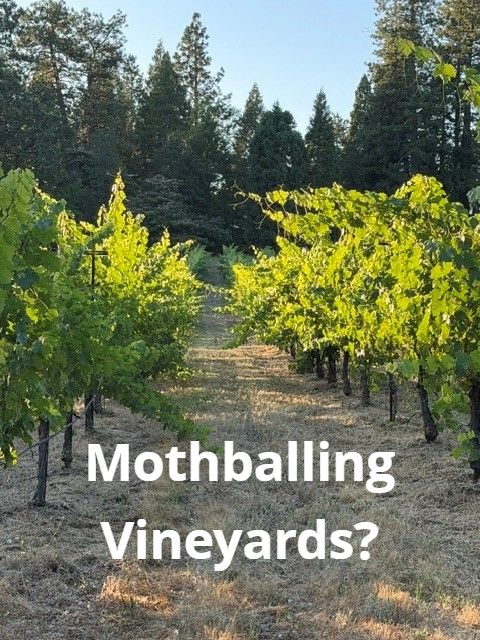
And of course, it's our vineyards that are the true lifeline to being prepared. Thus, the second article regarding 'Mothballing' a vineyard. Knowing that pulling out a vineyard and replanting a vineyard is time consuming and expensive, perhaps there is a way to farm a vineyard just enough to keep it healthy but not invest in that year's crop. When the market changes, the vineyard is poised to come back into production. (I think of it kind of like a hibernation mode when we travel to Mars!) And this is the studying that they are starting to do.
The fact is that you can't just let a vineyard go fallow for a couple of years. You still need to farm it to some degree, with sprays to keep pests and mildew at bay as well as irrigate and potentially fertilize. But if the grower isn't planning to harvest for that particular year, it isn't necessary to thin fruit, or leaf-thin (remove leaves for airflow), tuck the vines into the wires, etc. There are savings there for the farmer. And maybe you don't mow or disk but simply roll the cover crop (weeds) to keep thing under control. A farmer will make these investments to keep the vineyard ready to come out of "hibernation".
And for us at Madroña, we've actually made some of those decisions this year. We love our 50+ year-old vineyards, and we couldn't have another vineyard like it in our lifetimes if we pulled them out. But we also didn't need all the Zinfandel from these older vines this year. And we are particularly well-suited for "mothballing" a block because we cane-prune the vines (and not cordon-prune, for you vine geeks!). Add into this that these older Zin vines could use a year of just growing after having produced so much fruit over the years, it was a no-brainer to mothball the lower part of the block (and the Cab Franc next to it).
Ultimately, though, it's some new products out there (not in the US yet) from Australia where they've been practicing 'mothballing' for some time that are truly exciting. One is a spray that keeps the flowers of the vines from pollinating themselves that year. This means a vineyard wouldn't have to worry about grapes being grown, and the vine doesn't expend all the energy trying to ripen a crop you aren't going to pick.
Still, though, it's all about being ready for when people start to understand again that wine is a special product that is part of enjoying food and life. And then our old Zin vines will be ready to pop back into production, thanking us for the vacation!
So, sorry about the loooonnnnnnggggg set of comments here, but you all should be "in the know"! And now enjoy another glass of amazing El Dorado wine! Cheers!